
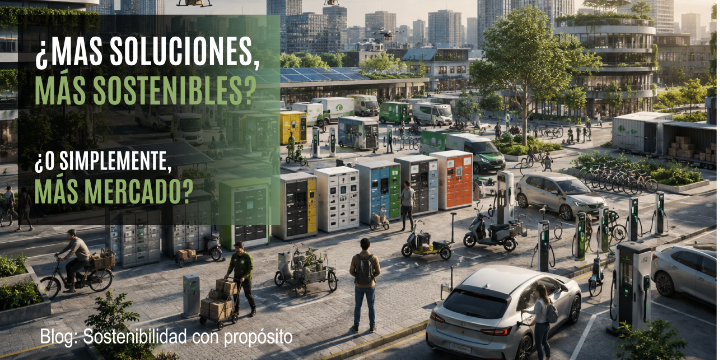
We are pleased to share a new opinion article by Joan Lluís Rubio López, Marketing and Sustainability Director at ADER Supergroup and a member of the Catalonia Logistics Cluster. This article is part of the "Sustainability with Purpose" blog. In this piece, Joan Lluís reflects on one of today's key questions: whether sustainability is truly transforming the logistics model or whether it is giving rise to a new industry with its own growth dynamics.
Businesses are not NGOs.
That is self-evident.
No one starts a business to lose money. Companies are created to generate value, compete, and survive. And that is not a flaw in the system. It is precisely what has driven economic progress over the past few centuries.
That is why it is so interesting to observe what is happening with sustainability.
Because sustainability was born, in essence, to correct the excesses of that very same system. To remind us that growth has limits, that resources are finite, and that certain externalities can no longer be ignored.
So far, everything seems perfectly logical.
Yet the more I observe the evolution of the market, the more one question keeps coming back to me.
What if sustainability is creating exactly what it set out to regulate?
An entirely new economy has emerged around sustainability.
Electric vehicle manufacturers.
Battery companies.
Charging infrastructure operators.
ESG consulting firms.
Emissions accounting software.
Reporting platforms.
Certification bodies.
Verification companies.
Carbon markets.
Carbon offset providers.
Smart locker manufacturers.
Locker network operators.
Drone manufacturers.
Technology platforms.
Monitoring systems.
Artificial intelligence applied to regulatory compliance.
And the list keeps growing.
There is nothing inherently wrong with that.
On the contrary.
It was inevitable.
Every major transformation creates new needs, and wherever new needs emerge, businesses emerge to solve them.
That is exactly how markets work.
But it also means that an entirely new industry has been born.
And like every other industry before it, it operates under exactly the same incentives.
Grow.
Acquire customers.
Expand.
Attract investment.
Open new markets.
Increase market share.
And this is where the paradox appears.
Sustainability has created an economy that must also continue growing in order to survive.
Perhaps the risk does not lie with these companies.
The real risk appears when the market begins feeding itself.
When success starts being measured by the number of certifications issued.
The number of platforms deployed.
The number of charging stations installed.
The number of lockers rolled out.
The number of solutions sold.
Because at that point we stop asking a much more important question.
Is all of this actually making the system more sustainable?
Or are we simply
building a new economy around sustainability?
Those are not the same question.
Just look at any city.
Every operator installs its own locker network.
Every company deploys its own charging stations.
Every manufacturer develops its own technological ecosystem.
Every platform wants to become the standard.
Every certification body promotes its own methodology.
Every software provider creates its own data model.
Every player builds its own infrastructure.
Individually, every one of these investments makes sense.
Collectively, however, they raise an uncomfortable question.
Are we simplifying the system... or making it increasingly complex?
Because nature rarely works by multiplying solutions.
It works by sharing resources.
There is an extraordinarily simple example.
The mailbox.
For decades, postal systems handled millions of deliveries using a single shared infrastructure.
There was not one mailbox for every postal operator.
There was simply one mailbox.
Universal.
Interoperable.
Accessible to everyone.
Shared.
And precisely because of that, it was remarkably efficient.
Probably one of the most sustainable logistics infrastructures ever created.
It required no artificial intelligence.
No sensors.
No mobile apps.
No digital platforms.
It required something much harder to achieve.
A shared agreement.
Perhaps there is a lesson there that we are overlooking.
Sustainability should not be limited to electrifying vehicles or deploying new infrastructure.
It should also aspire to create shared solutions.
Universal.
Interoperable.
Capable of generating collective efficiency rather than merely individual competitive advantages.
Because when every company develops its own ecosystem, its own platform and its own infrastructure, it is fair to ask whether we are truly optimizing resources...
Or simply redistributing business opportunities.
I am not writing these lines to question sustainability.
Quite the opposite.
I believe in it deeply.
But precisely because of that, I also believe we should be willing to question the industry growing around it.
Because creating sustainable solutions is one thing.
Creating an economy whose survival depends on continuing to sell sustainability is something very different.
The two ideas are similar.
But they are not the same.
Perhaps the sustainability of the future will not be measured solely by the tonnes of CO₂ we avoid emitting.
Perhaps it should also be measured by our ability to build systems that are simpler, more shared and more universal.
Because there is one final paradox we should not ignore.
What if the greatest challenge facing sustainability is no longer reducing our emissions... but preventing the sustainability industry itself from reproducing the very same growth model it was created to correct?


Comments